 The Tridentine Doctrine of Justification The Tridentine Doctrine of Justification
The Council of Trent
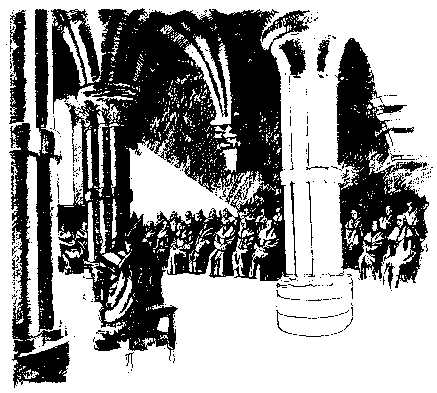
The Council of Trent was a general council of the Roman Catholic Church. Its sixth session, January, 1547, met to define the Catholic doctrine of justification. The council issued a series of thirty canons on justification. Following are two of them:
Canon 1. If anyone says that man can be justified before God by his own works, whether done by his own natural powers or through the teaching of the law, without divine grace through Jesus Christ, let him be anathema.
Canon 3. If anyone says that without the predisposing inspiration of the Holy Ghost and without His help, man can believe, hope, love or be repentant as he ought, so that the grace of justification may be bestowed upon him, let him be anathema.
The council also decreed that Christ merited our justification by His death on the cross, and also that "none of those things that precede justification, whether faith or works, merit the grace of justification. For, if by grace, it is not now by works, otherwise, as the Apostle says, grace is no more grace."1
According to Roman Catholic Doctrine, What Is Justification?
1. According to the Council of Trent
. . . if they (men) were not born again in Christ, they would never be justified, since in that new birth there is bestowed upon them, through the merit of His passion, the grace by which they are made just.
. . .justification . . is not only a remission of sins but also the sanctification and renewal of the inward man through the voluntary reception of the grace and gifts whereby an unjust man becomes just and from being an enemy becomes a friend. . .
. . .the . . . formal cause (of justification) is the justice of God, not that by which He Himself is just, but that by which He makes us just, that, namely, with which we being endowed by Him are renewed in the spirit of our mind, and not only are we reputed but we are truly called and are just.
. . .no one can be just except he to whom the merits of the passion of our Lord Jesus Christ are communicated, yet this takes place in that justification of the sinner, when by the merit of the most holy passion, the charity of God is poured forth by the Holy Ghost in the hearts of those who are justified and inheres in them; whence man through Jesus Christ, in whom he is ingrafted, receives in that justification, together with the remission of sins, all these infused at the same time, namely, faith, hope and charity.
Canon 11. If anyone says that men are justified either by the sole imputation of the justice of Christ or by the sole remission of sins, to the exclusion of the grace and the charity which is poured forth in their hearts by the Holy Ghost, and remains in them, or also that the grace by which we are justified is only the good will of God, let him be anathema.
2. According to the Roman Catholic Douay Version
The editors of the Douay Version of the Bible have placed these words in the footnotes for Romans 3 and 4:
The justification of which St. Paul here speaks is the infusion of sanctifying grace which alone renders a person supernaturally pleasing in the sight of God.
But justification, that is, an infusion of sanctifying grace, cannot be merited by us; it is an entirely gratuitous gift of God.
Verse 5. Credited to him as justice: when God, who is infinite truth, credits something to man, it is equivalent to saying that He imparts it really to man; for there is no make-believe with God.
3. According to Modern Roman Catholic Authors
The following excerpt is from The Life of Grace, by P. Gregory Stevens, O.S.B., a representative modern Roman Catholic author:
Justification. St. Paul often uses the words "just" and "justice" of genuine religion and its true followers. This use is in accord with the usual and general scriptural meaning of these terms. Justification, especially in Paul's epistles to the Romans and to the Galatians, is the process or the action by which God sanctifies man, that is, by which God makes man pleasing to him. The notion may be extended to the use of the term justice as a designation of the whole inner reality of the Christian life of grace. St. Paul recalls the sanctification or justification of Abraham, who appears as the symbol or the great example in the Old Testament of the bestowal of gratuitous grace by God: "Even thus, 'Abraham believed God, and it was credited to him as justice.' (Gen 15,6) Know therefore that the men of faith are the real sons of Abraham." (Gal 3,6f) An understanding of Abraham's faith and his justification before God is thus set forth by Paul as a way of seeing the sanctification of the Christian, who must be justified by God as was Abraham: "For there is no distinction, as all have sinned and have need of the glory of God. They are justified freely by his grace through the redemption which is in Christ Jesus. . . . . (Rom 3, 22-24)
Paul is writing to oppose those Jews and Christians who saw justification as something to be accomplished by a person through his own good works. In this aberration, man was seen as bringing about grace as a reward or even as a salary from God for good deeds done. Paul vigorously opposes this religion of human self-sufficiency, denying, as we have seen, man's power to perform the good works of the Law, and constantly affirming that justification is a work of God bestowed on faithful men as a free divine gift. The Apostle strongly opposes a religion based on "boasting," on self-sufficiency before God. Such a religion is injurious to the divine goodness and is based on an unreal view of the human condition.
What is the reality of the justification accorded by God when man cooperates in faith? Is it merely like a statement of God declaring the sinner just? Or is it a divine act by which the sinner is internally transformed and becomes a new reality before God? Catholic thought has always been that the justice bestowed on man is a gratuitous gift (Gal. 3,6ff), and a true justice which actually transforms man into a person pleasing to God. St. Paul links justice and justification with sanctification and purification (1 Cor 6,11), and sees the justified man as living a new life in Christ. (Rom 6,15-23; 3,21-26) The liberation from sin and death, already described, is a spiritual reality which is accomplished in man by grace at the moment of justification. Its effect is to introduce man into a genuine state of justice. This new life is indeed life in Christ, so real that Paul can say: "With Christ I am nailed to the cross. It is now no longer I that live, but Christ lives in me. And the life that I now live in the flesh, I live in the faith of the Son of God." (Gal 2,19f)
Thus justification initiates a new life which is a sharing by the Christian in the life of Christ himself. St. Paul teaches as clearly as does St. John that grace is a new existence communicated in the power of the death and resurrection of Christ. The whole of Romans 6 may be read at this point. It summarizes Paul's realistic understanding of the incorporation into Christ, the dying to sin and rising to a new life, which is accomplished in the process of justification.
Newness of Life. Justification is thus synonymous with the communication of new life in Christ to the Christian. St. Paul frequently contrasts the "old man" of sin and the flesh with the "new man" who is spiritual and dedicated to a fundamental holiness. "If any man is in Christ, he is a new creature." (2 Cor 5,17; cf. Gal 6,15.) Because God has created us "in Christ Jesus" (Eph 2,10), the Christian is to live this new life. "But be renewed in the spirit of your mind, and put on the new man, which has been created according to God in justice and holiness of truth." (Eph 4,23f; cf. Col 3,10.) The liturgy of Easter is especially devoted to this theme of new life won for us in Christ, and communicated to us in the sacraments. Entrance into the Christian life is truly a "regeneration" and a "renewal": the equivalent of being "justified by his grace." (Ti 3,6f) Just as in the third chapter of John's gospel we saw how real was the notion of rebirth, so Paul stresses this point, that the Christians to whom he writes may be thoroughly convinced of the mysterious and hidden, yet actual, presence of grace. This conviction in them will lead, in turn, to their living in the light, (Eph 5,8f), to action which gives expression to the new "reality" which Christians have become. . . . .
 The Council of Trent The Council of Trent
Catholic doctrine on these questions, formulated in opposition to Lutheranism, was presented in full at the Council of Trent, as it had been previously by Pope Leo X in the Bull "Exsurge Domine" of June 15, 1520. The teaching of Trent centers on two points of fundamental importance for the understanding of the Catholic doctrine on grace. First of all, justification is a real and profound transformation of man, a genuine gift of sanctification to him. It can in no way be reduced to something purely external. Second, man is not deprived of freedom, but cooperates through grace in justification and the process of salvation. Justification is not solely the action of God, in other words, but a process in which man participates. We may follow the order of the Council in expressing these doctrines.
The reality of the effects of original sin is that "all men had lost innocence in the sin of Adam" (D793; TCT557); this means that all are "born without justice." (D795; TCT559) That does not, however, connote a total corruption of men, for "their free will, though weakened and unsteady, was by no means destroyed." (Ibid.) Sinful man is estranged from God and unable to attain salvation except through Christ, for it is only in Christ that we "might secure justice and that all might receive the adoption of sons." (D794; TCT55B)
We may note the Council's insistence on a genuine securing of justice by man, thus stressing the reality of the divine gift of grace. This redemption by Christ, the only means of salvation for man, comprises a genuine transformation. "So, likewise, they (men) would never have been justified except through rebirth in Christ, for this rebirth bestows on them, through the merit of his passion, the grace by which they are justified." (D795; TCT559) These solemn declarations reaffirm Catholic faith in opposition to Lutheranism, as well as to any revived Pelagian spirit (cf. DBl1f; TCT575f.) Man cannot save himself but is saved only in the transforming grace of Christ. A brief definition is then proposed: "Justification is a passing from the state in which man is born a son of the first Adam, to the state of grace and adoption as sons (Ram 8,15) of God through the Second Adam, Jesus Christ our Savior." (D796; TCT56O) The Council immediately adds that this transformation demands baptism or at least the desire of baptism. thus affirming in the very heart of the work of salvation the basic principle of sacramentality.
Justification
In a clear, religiously profound statement the Council defines the inner nature and structure of justification. It does so in direct opposition to the extrinsecist position of Reformation theology. The heart of Catholic teaching is contained in this passage. First of all comes the assertion that "justification is not only the remission of sins, but sanctification and renovation of the interior man through the voluntary reception of grace and the gifts, whereby man becomes just instead of unjust, a friend instead of an enemy, that he may be an heir in the hope of life everlasting." The Council then details the causes of this inner transformation: its goal and purpose is God's glory; it is brought about by God through the merits of our Redeemer, and communicated to man in faith and baptism.
Trent's Idea of Grace
As part of the Lutheran views of salvation, of the corruption of medieval thought, the Council states:
The unique formal cause is the justice of God, not the justice by which he is himself just, but the justice by which he makes us just, namely, the justice which we hove as a gift from him and by which we are renewed in the spirit of our mind. Not only are we considered just, but we are truly said to be just, and we are just, each one of us receiving within himself his own justice, according as the measure of the Holy Spirit imparts to each one as he wishes, and according to the disposition and cooperation of each. (D799; TCT563)
In the solemn words of a condemnation, the Council rejects the notion that this grace is "through the imputation of Christ's justice alone" (D821; TCT585; cf. D820; TCT5B4.) Without giving a detailed theological explanation of formal causality, the Council affirms that the inner structure of the justification of man is not something identical with God or Christ, but is a gift bestowed by God in Christ by which man is made just; it is something proper to man transformed in Christ.
The whole Catholic theology of grace as a created reality, distinct from God himself, and bestowed upon man as something personal to him is here stated by the Council. Furthermore, this justice within man inheres within him as a permanent principle: "The charity of God is poured forth by the Holy Spirit into the hearts of those who are justified and inheres in them." (D800; TCT564) Again, in the words of a definitive condemnation: "If anyone says that men are justified . . .excluding grace and charity which is poured forth in their hearts by the Holy Spirit and inheres in them . . . let him be anathema." (1)821; TCT585) What theology calls "sanctifying grace" is here determined and defined as opposite to the Lutheran teaching of a kind of justification which does not inwardly transform man but remains extrinsic to him.— pp. 33, 34, 56-59.
———————————————————————————
 Summary of the Roman Catholic Doctrine of Justification Summary of the Roman Catholic Doctrine of Justification
Roman Catholic theology professes that justification is by God's grace. It sees justification as God's act of regenerating a sinful man. God pronounces a man just only when he is just; the divine verdict is only a statement of what is actually true in the man himself.
Roman Catholic theology reduces justification to an operation within man. God's justification is simply man's sanctification.
Roman Catholic Teaching on Merit
Roman Catholicism teaches that Christ's merit initiates our salvation, but it views "infused grace" as merit that God puts within a man. In this way Christ's merit becomes human merit.
Catholic theologians clearly affirm that there is no merit in "good works" done by a sinner. But when "good works" are done by sanctifying grace in the man, they regard such works as truly meritorious.
In short, Catholicism affirms the saving merit of infused righteousness (the work of the Holy Spirit in man). Following are extracts from two representative Roman Catholic books:
1. A Doctrinal Catechism
by Stephen Keenan
Chapter III.
Q. Can any one, who is in a state of mortal sin, merit heaven by any good work or works?
A. No; he can neither merit justification, nor heaven; because, all the works he performs while in a state of mortal sin are dead works, and of course have no merit.
Q. Can one who is in a state of grace merit heaven?
A. The just, who are in a state of grace, may, by good works, merit an increase of glory, but even they can never, by any or every good work, merit the first degree of glory, that is, a right to heaven.
Q. To whom do we owe our permission to enter heaven?
A. Solely to the mercy of God and the merits of Jesus Christ: for it is by the sufferings and death of Jesus that we acquired heaven as our inheritance; and it is God's mercy alone, which gave us such a Mediator and Redeemer.
Q. Why have you said that the just may, by good works, merit an increase of glory in heaven?
A. Because, in Scripture, heaven is proposed to us as a recompense, and a recompense or reward is due only to merit.
Q. What does St. Matthew say on this matter? (Chap. v, 12.)
A. "Be glad and rejoice, for your reward is very great in heaven." In Prov. chap. xi, 18 — "But to him that soweth in justice, there is a faithful reward." St. James, chap. i, 12 — "Blessed is the man that endureth temptation, for when he hath been proved, he shall receive the crown of life, which God hath promised to them that love him." St. Paul, 2 Tim. chap. iv, 7, adds: "I have fought a good fight, I have finished my course, I have kept the faith; as to the rest, there is laid up for me a crown of justice, which the Lord, the just judge, will render to me in that day."
Q. What have Protestants to object against this Scriptural doctrine?
A. Nothing that is either rational or Scriptural; for the learned among themselves have taught the very same. The Apology for the Protestant Confession of Augsburg, p.96, says: "We teach, that good works merit a temporal and spiritual reward in this world, as well as in the next."
Q. What then have Protestants to say to Catholics on the subject of merit and good works?
A. All they have to say arises from their ignorance of the Catholic doctrine.
Chapter IV.
Q. What is that which gives their value to good works?
A. Sanctifying grace, which is within us.
Q. Is this sanctifying grace our own, or is it from God?
A. It is the pure gift of God's liberality to us.
Q. How does St. Paul express himself on this subject? (Rom., chap. v, 3.)
A. "The charity of God," he says, "is poured forth in our hearts by the Holy Ghost, who is given to us.
Q. What are the effects of sanctifying grace?
A. It makes us the friends and children of God.
Q. To whom do we owe this inestimable grace?
A. To the merits of Jesus Christ, and to these alone.
Q. Have you any thing to remark on the efficacy of the merits of Christ?
A. Yes; he was not satisfied with meriting heaven for us; he also, by his grace, put us in a condition to merit greater degrees of glory in heaven.
Q. Does not our Saviour say, Luke, chap. xvii, 10 —"So you also, when you shall have done all those things that are commanded you, say, we are unprofitable servants?"
A. This is quite in accordance with our doctrine; we are certainly unprofitable servants to God, whatever good we do; for nothing which we can do, either adds to, or takes from, his essential glory. We are not, however, unprofitable servants to ourselves, since these good works secure for us the rewards God has been pleased to promise.
Q. Could God order us to perform good works without promising us any recompense?
A. Certainly; because we are his creatures, and the grace which enables us is his. The Council of Trent, Sess. xvi, chap. 16, says: "God's goodness to man is so great, that he even desires his own gifts to be converted into our merit."
Q. Have we reason to trust much in our good works?
A. "God forbid," says the same Council, "that any Christian should glory, or confide in himself, and not in the Lord."
Q. How is it, then, that Protestants reproach Catholics with placing too much confidence in their good works?
A. They reproach us, because they do not know us; and the only return we should make for their ill treatment of us, is to pray, as Christ did for the ignorant Jews, who put him to death: "Father, forgive them, for they know not what they do."
Chapter V.
Q. Can a man satisfy for his own sins?
A. No; neither man nor angel, nor both men and angels, can ever satisfy for one mortal sin. Jesus Christ alone could and has satisfied for our sins.
2. The Life of Grace
by P. Gregory Stephens, O.S.B.
Merit
As part of the Lutheran views of salvation, of the corruption of man's nature and freedom, and of the extrinsecism of justification, there came a denial of the traditional Catholic doctrine of merit. Against this conclusion of Reformation theology the Council of Trent reasserted the reality of merit through grace, indicating again thereby the reality of man's action in the order of salvation. Because of his union with Christ in grace, man is enabled to work for his own eternal beatitude. He merits heaven by the power of grace and his free cooperation in performing good works.
Eternal life should be set before those who persevere in good works to the end and who hope in God. It should be set before them as being the grace that God, through Jesus Christ, has mercifully promised his sons ... and as the reward which, according to the promise of God himself, must assuredly be given them for their good works and merits. (D809; TCT573)
It is because of God's creative love for man that he promises to reward the merit of man's good works. It is a proof of the efficacious reality of that love that human actions attain this high value before God.
Although in Holy Scripture high value is placed on good works (Mt 10,42)... nevertheless a Christian should have no inclination to rely on himself or to glory in himself instead of the Lord (cf. 1 Cor 1, 31; 2 Cor 10,17), whose goodness toward all men is such that he wants his gifts to be their merits. (D810; TCT574)
The work of man's salvation is invariably the work of God's grace, but the affirmation of the reality of grace necessarily involves, in Catholic thought, the corresponding affirmation of man's free cooperation. This cooperation is not a mere passive openness or receptivity; it is an active engagement in the life of justice and righteousness. The reality of this human activity is affirmed not only in its immediacy in this world but in its effects before God himself.
The doctrine of merit is a fitting way to conclude the treatment of the Council of Trent, for merit comes as a crown to man's acts. This is not to imply that merit is an extrinsic reward, a sort of present given by God for good behavior. The doctrine of merit is not added to the doctrine of man's inner cooperation with grace as an afterthought, It is merely the definition of a property or quality inherent in the good works of grace, and demonstrates very clearly the totality of the Catholic affirmation of grace. Merit is not in any sense an arbitrary aspect of the good act. It is proof that in the good act man disposes himself before God, and that the reality of good works is of more than merely passing and terrestrial importance.
The doctrine of the Council is found in summary form in this condemnatory statement:
If anyone says that the good works of a justified man are gifts of God to such an extent that they are not also the merits of the justified man himself; or that, by the good works he performs through the grace of God and the merits of Jesus Christ (of whom he is a living member), the justified man does not truly merit an increase of grace, life everlasting and, provided that he dies in the state of grace, the attainment of that life everlasting, and even an increase of glory, let him be anathema. (D842; TCT6O6)
This is the essential Catholic teaching on the reality of merit. The first part of the condemnation is a direct refutation of a fundamental Reformation intuition: that God's action in justification and salvation really removes all genuine and intrinsic human cooperation with grace. The Council reaffirms the Catholic doctrine — which, as mentioned, is always a simultaneous affirmation of the reality of the divine causality and that of man. Because good works of the supernatural order are done with the aid of grace from beginning to end, it does not mean in any way that the reality of man's causality is diminished. Grace does not disregard or do away with human freedom. It heals it from within, so that man is able to perform freely and meritoriously good acts which are his.
Finally, the Council teaches that man, in this life, merits an increase of grace. This, of course, is not a quantitative matter but a question of both intensity and the deep-rootedness of grace in the very being of the justified man. In traditional theological terms, the state of grace is qualitatively intensified. This means that man is more closely assimilated to Christ with whom he is united. Looking to the final destiny of man, the Council affirms that good works performed in this life are meritorious of everlasting life in heaven; there man's assimilation to Christ will be complete, there the life of grace will find its inner and total development. — pp.62, 63.
1 See article 7 in this issue, "The Council of Trent," for the entire "Decree Concerning Justification."
|